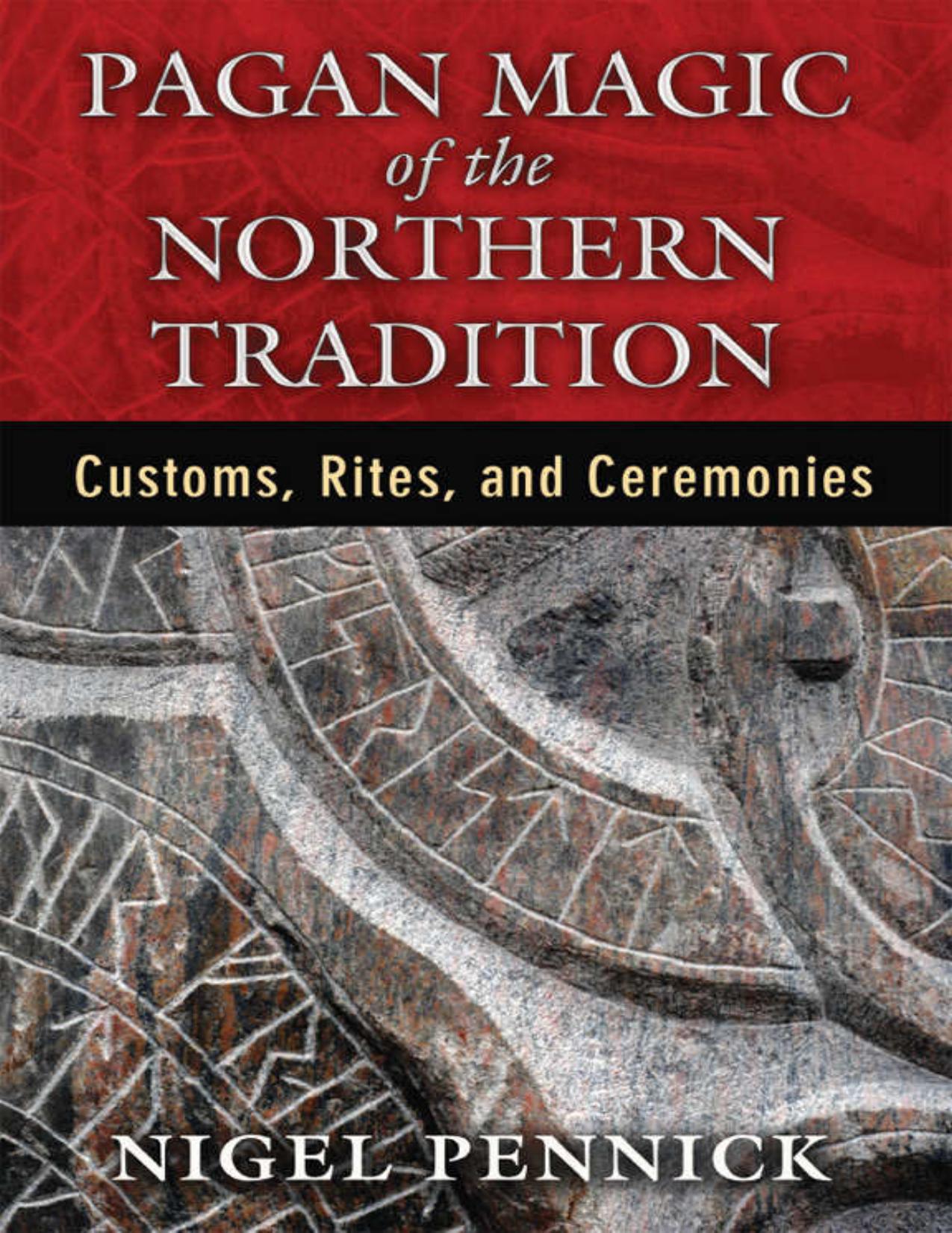
Pagan Magic of the Northern Tradition: Customs, Rites, and Ceremonies by Nigel Pennick
Author:Nigel Pennick [Pennick, Nigel]
Language: eng
Format: epub, azw, pdf
Tags: Spirituality/Paganism
ISBN: 9781620553909
Publisher: Inner Traditions/Bear & Company
Published: 2017-05-06T04:00:00+00:00
Fig. 10.3. Primitive Methodist Chapel, Black Horse Drove, Cambridgeshire, England, site of the last known horse-head foundation rite.
A practice of stable-building magic was recorded in the ninteenth century at Kiiminki, Finland. A horse made from alder wood was made when a new stable was built. It was covered with a blanket belonging to a woman who had recently given birth, The horse’s eyes were marked by the woman’s blood. A mixture of barley grains and quicksilver (mercury) was placed in front of the alder horse in a basket, and the whole assemblage was buried under the threshold of the new stable to protect the building and its horses. If the alder horse is inverted, it will kill the horses in the stable. If a thief steals the alder horse and puts it under his or her stable, the protection and luck is transferred. A means of destroying the good fortune of the stable is to steal the alder horse, carry it around the perimeter of the pasture, then bury it upside down by an anthill to the north of the field. Then the horses pastured there will die, and the only remedy is to abandon the stable and build a new one in a different location (Hukantaival 2009, 350–56).
The Museum of Cambridge has a number of horse fragments recovered from old buildings, both from Histon: half a jawbone found bricked into a chimney and a leg bone from another chimney. Another horse leg bone was found in 1959 in the building that houses the museum, the former White Horse Inn. In the nineteenth century, beneath part of the Norman gatehouse of Bury St. Edmunds Abbey, twenty-one skulls were found. Twenty were wolf skulls, and one was that of a wolfhound. Bones were a building material in former times, and floors were made from them, such as in a house at Fulbourn, Cambridgeshire, whose hall floor was of sheep bones (Evans 1971, 200). But clearly cats, dogs, chimney bones, and horse skulls were not structural materials.
From early times, however, the bones of large whales were used to build houses. In his 1655 description of the north, Olaus Magnus wrote that people constructed houses erected from whole whale ribs. After the whales had been defleshed, the skeletons were left to the weather until they were totally disarticulated, cleaned, and whitened. Then they were taken to a suitable place and erected like a cruck house, where the walls and roof are integral. The structural bones were covered with suitable material and smoke holes left in the roof ridge or at the sides. Internally the house was divided up into separate rooms. Doors were made from whale skin leather. The remains of a few houses of whalebone existed until recently in Greenland, Ireland, England, and Germany, mostly at ports where whaling had been a major concern (Redman 2004, passim).
Download
Pagan Magic of the Northern Tradition: Customs, Rites, and Ceremonies by Nigel Pennick.azw
Pagan Magic of the Northern Tradition: Customs, Rites, and Ceremonies by Nigel Pennick.pdf
This site does not store any files on its server. We only index and link to content provided by other sites. Please contact the content providers to delete copyright contents if any and email us, we'll remove relevant links or contents immediately.
Animal Frequency by Melissa Alvarez(4473)
Sigil Witchery by Laura Tempest Zakroff(4246)
Real Magic by Dean Radin PhD(4129)
Fingerprints of the Gods by Graham Hancock(4004)
Aleister Crowley: The Biography by Tobias Churton(3640)
Journeys Out of the Body by Robert Monroe(3624)
Alchemy and Alchemists by C. J. S. Thompson(3522)
The Rosicrucians by Christopher McIntosh(3520)
Mysteries by Colin Wilson(3455)
Hitler's Monsters by Eric Kurlander(3343)
The Hatha Yoga Pradipika (Translated) by Svatmarama(3342)
Wicca: a guide for the solitary practitioner by Scott Cunningham(3179)
John Dee and the Empire of Angels by Jason Louv(3166)
Infinite Energy Technologies by Finley Eversole(2984)
Book of Life by Deborah Harkness(2939)
Dark Star Rising by Gary Lachman(2867)
The Book of Lies by Aleister Crowley(2847)
Aliens by Jim Al-Khalili(2830)
To Light a Sacred Flame by Silver RavenWolf(2823)
